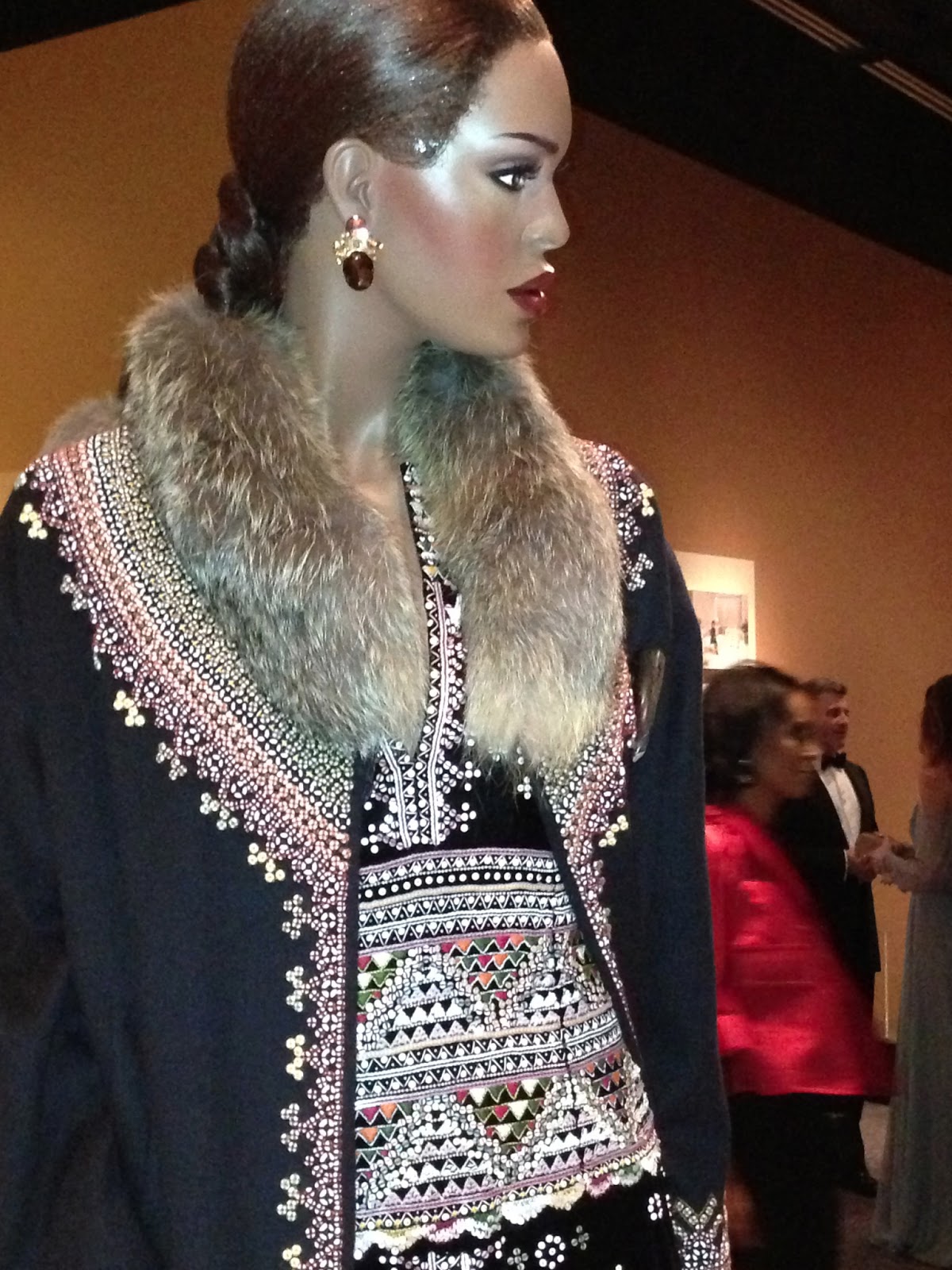
Musée Pierre Cardin.
On my recent trip to Paris, I visited the Musée Pierre Cardin located in the Marais neighborhood. It showcases an amazing collection of Pierre Cardin’s clothing, jewelry, accessories and furniture, ranging from his earliest pieces to contemporary ones.
It is truly a mecca for all things “Cardin” and includes three floors and over 200 pieces of Cardin’s haute couture creations.

Interior of Musée Cardin.

Accessories room, Musée Pierre Cardin.

Pierre Cardin gloves from the 1960s, Musée Pierre Cardin.
The museum opened in November 2014, and is curated by Cardin’s longtime assistant and apprentice, Renée Taponier, who has worked for Cardin for over 50 years, having started with him when she was only 14 years old.

Me with Madame Taponier.
Pierre Cardin is perhaps best known for his licenses — his name is on hundreds of products, everything from cologne to underwear to linens to ties. At its height, Cardin had more than 800 licenses in 140 countries. Unfortunately, many of the licensed products were not well made, leaving the impression that the Cardin brand was shoddily made or low-end. However, it wasn’t always this way. In fact, the Cardin label had been a part of the haute couture system and for many years catered only to wealthy clientele. But Cardin has always been a forward thinker and anticipated the monetary and branding power of licensing years before Ralph Lauren, Calvin Klein and Donna Karan came along.
The shrewd entrepreneurial skills and business foresight that Cardin has displayed throughout his career have made him one of the world’s wealthiest designers and a household name. Cardin’s vision led to a number of firsts: Not only was he the first couturier to sign licensing agreements, but he was also the first to create a ready-to-wear line and the first to open up markets in Japan and China.

Pierre Cardin on the December 23, 1974, cover of Time.
Pierre Cardin was born on July 2, 1922, in Northern Italy to French parents. Originally, he was named Pietro Cardin. Cardin moved with his parents to France when he was 2 years old and later moved to Paris when he was 23 years old. There, he worked first with the house of Paquin, then Schiaparelli, and finally Dior, where he was credited with having helped create Dior’s revolutionary “New Look.”
In 1950, Cardin founded his own company. He presented his first women’s collection in 1953. In 1954, Cardin designed his “bubble dress,” which became an immediate international success. That same year, he opened his first boutique called Eve, located at 118 rue du Faubourg Saint-Honoré.
Cardin’s early designs were much more conservative and “Dior-like” than the avant-garde designs of the 1960s and 1970s for which he is best known. In Chicago, we are lucky to have a rare example of Cardin’s early work at the Chicago History Museum. The two-piece, green tweed ensemble below was designed by Cardin in 1956. It was owned by Chicagoan Eloise Wright Martin, who purchased it at the Chicago department store Blum’s and donated it to the museum in 1980.

1956 Pierre Cardin dress, collection of the Chicago History Museum.
In 1959, Cardin became a member of the Chambre Syndicale, a French association of haute couture designers. Also in 1959, Cardin produced a ready-to-wear collection for the department store Printemps. At the time, this was a shocking idea and had never been done by an haute couture designer. It caused an uproar in the fashion world, but Cardin was always forward-thinking and wanted to design for everyone, not just the wealthy who could afford his couture designs. Of this, he said, “I ask myself: Why is it that only rich people can access exclusive fashion? Why can’t a man or woman off the street do so? I could change this rule. And I did.” By doing this, he was able to greatly expand his audience and his brand. Many designers would go on to follow his example.
In 1960, Cardin presented his first collection for men. One of the items was a suit with skinny trousers and a cylindrical, collarless jacket. It was to become the influence for the suits worn by the Beatles in the early 1960s.

1964 Beatles album cover featuring suits influenced by Pierre Cardin’s design.
Cardin’s 1960s women’s designs showed his interest in architecture. They were structural in appearance and were made out of stiff, crisp fabrics like wool crepe and jersey. Many of his dresses were made in the form of geometric shapes and decorated with circular and rectangular motifs.

Pierre Cardin dresses from 1966, Musée Pierre Cardin.
The 1960s brought about the possibility of travel to space. This greatly influenced Cardin’s designs and led him to create his iconic “Space Age Look,” the idea of dressing for the future. He incorporated metallic fabrics and Space Age textiles such as vinyl into his designs. Some of his fashions were made entirely of plastic and metal. He used large industrial zippers and even designed helmet-like hats influenced by astronauts’ headgear. In 1968, he created his own fabric called “Cardine,” a bonded, uncrushable fiber incorporating raised geometric patterns.

Pierre Cardin 1968 vinyl and plastic ‘Space Age’ dresses, Musée Pierre Cardin.

Pierre Cardin 1968 dresses made out of ‘Cardine’ fabric, Musée Pierre Cardin.
In the 1970s, in response to the miniskirts of the 1960s, Cardin created the “long longuette” or maxi dress. An example of this longer silhouette can be seen below, exhibited at the Chicago History Museum’s 2012 show, “50 Years of Ebony Fashion Fair.” The dress is a fall/winter look from 1970 and is made of double-faced wool and PVC. It was bought by the founder of Ebony magazine, Eunice Johnson, for the Ebony Fashion Fair, a runway show she created that traveled around the U.S. from 1958 to 2009, displaying high fashion for an African-American audience.

Pierre Cardin dress from the “50 Years of Ebony Fashion Fair” exhibit at Chicago History Museum.
The dress below is an example of a later 1970s Cardin piece. The 1970s brought more fluid materials and techniques to Cardin’s designs. A spiraling, rather than geometric, line began to be more noticeable, and Cardin became known for his frothy evening dresses of layered, printed chiffon.

1970’s Pierre Cardin dress, Musée Pierre Cardin.
Much like his clothing designs, Cardin’s jewelry designs looked to the future for inspiration. They tended to be large statement pieces with a sculptural quality.

1970’s Pierre Cardin bracelet, Musée Pierre Cardin.

PIerre Cardin 1972 necklace, Musée Pierre Cardin.

Pierre Cardin 1960s bracelet, Musée Pierre Cardin.

Pierre Cardin 1980s necklace, Musée Pierre Cardin.
In 1977, Cardin launched an haute couture furniture line that translated his sculptural approach to fashion into furniture. He referred to the furniture as “utilitarian sculptures.” He used futuristic forms which were translated into furniture using traditional cabinet-making techniques.

Pierre Cardin ‘Mantra Unit’, 1977, Musée Pierre Cardin.

Pierre Cardin 1970s cabinet, Musée Pierre Cardin.

Pierre Cardin 1970s circle storage unit, Musée Pierre Cardin.
Today, Pierre Cardin is 93 years old and still going strong. He continues to design for the Pierre Cardin label and owns the famous Maxim’s restaurant in Paris, as well as the Maxim’s brand. Cardin continues to look forward to the future. When Cardin was 87, he was quoted in the book Pierre Cardin: 60 Years of Innovation by Jean-Pascal Hesse as saying, “My destiny is tomorrow.”